Introduction
Artificial Intelligence has evolved far beyond simple chatbots and automation tools. One of the biggest shifts happening today is the rise of AI agents — systems capable of thinking through tasks, making decisions, using tools, and completing complex workflows with minimal human involvement.
AI agents are beginning to reshape how businesses operate, how people work, and how digital systems interact with users.
Many experts believe AI agents could become as transformative as the internet itself.
What Is an AI Agent?
An AI agent is an intelligent system designed to perform tasks autonomously by:
- Understanding goals
- Making decisions
- Using available tools
- Accessing information
- Completing multi-step actions
- Learning from feedback
Unlike traditional AI chatbots that simply respond to prompts, AI agents can actively execute workflows and handle processes.
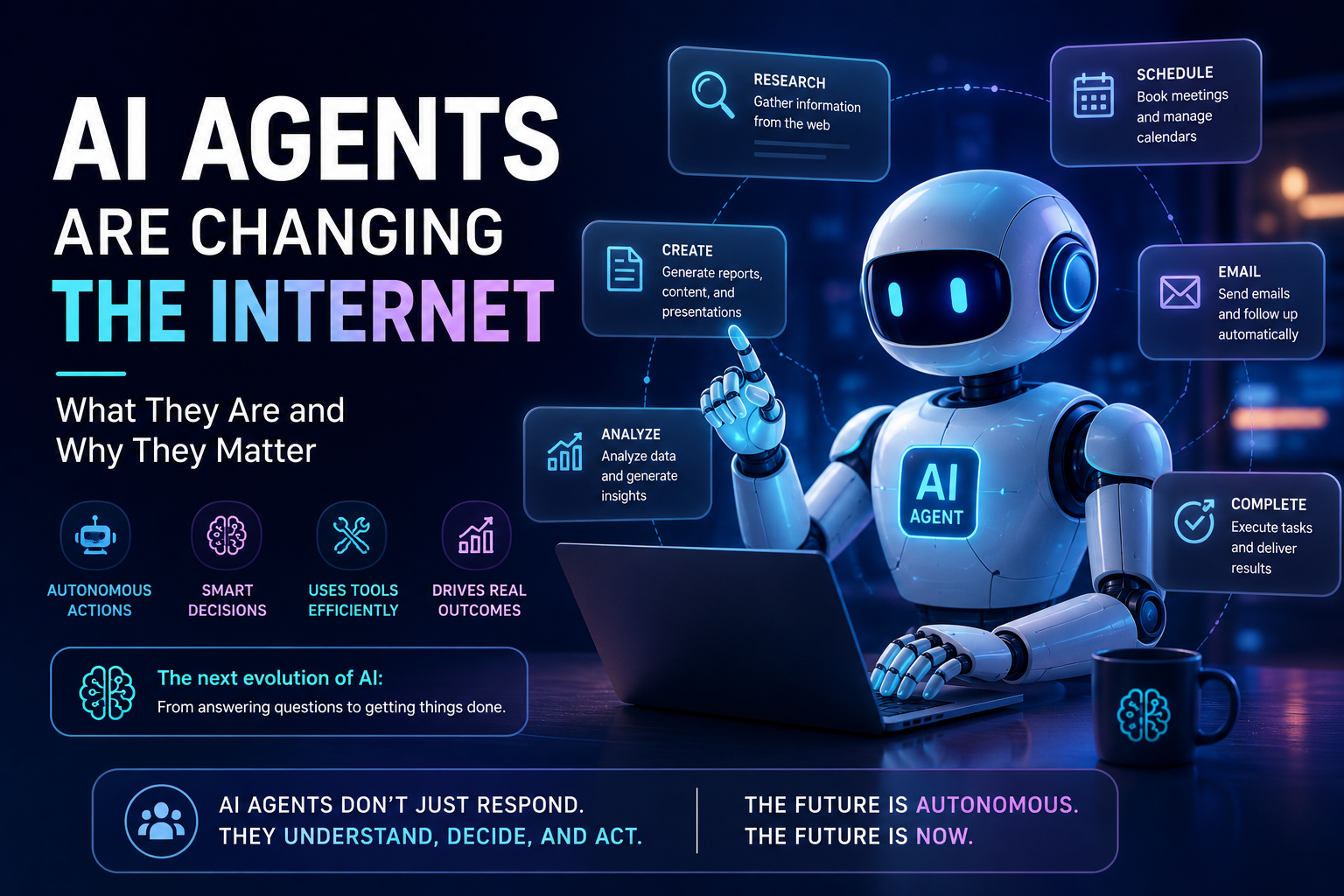
For example, an AI agent could:
- Research a topic
- Summarize findings
- Create a presentation
- Send emails
- Schedule meetings
- Analyze data
- Generate reports
—all without constant human guidance.
How AI Agents Work
AI agents combine multiple technologies together, including:
- Large Language Models (LLMs)
- Memory systems
- APIs and external tools
- Automation workflows
- Decision-making logic
The process generally looks like this:
- Receive a goal
- Break the goal into smaller tasks
- Decide the best approach
- Use tools or gather information
- Execute actions
- Review results
- Improve responses over time
This makes AI agents significantly more powerful than standard automation systems.
Real-World Examples of AI Agents
1. Customer Support Agents
Businesses are deploying AI agents that can:
Answer customer queries
Access databases
Process refunds
Escalate issues
Handle support tickets
These systems reduce response times and improve customer experience.
2. Marketing & Content Agents
AI agents can now:
Generate blog articles
Create social media posts
Analyze campaign performance
Suggest marketing strategies
Automate email workflows
This helps teams produce more content with greater efficiency.
3. AI Coding Assistants
Developers increasingly use AI agents for:
Writing code
Debugging issues
Explaining logic
Creating documentation
Testing applications
AI-assisted development is becoming a major productivity advantage.
4. Personal Productivity Agents
Individuals are beginning to use AI agents as digital assistants for:
Task management
Research
Scheduling
Note organization
Learning support
Workflow automation
AI agents can reduce repetitive work and improve focus.
Final Thoughts
AI agents represent one of the most significant shifts in the evolution of artificial intelligence.
They are changing AI from a passive assistant into an active digital collaborator capable of executing meaningful work.
For businesses, professionals, students, and creators, understanding AI agents today could become an important advantage tomorrow.
The future may not belong to those who simply use AI tools — but to those who understand how to work alongside intelligent AI systems effectively.